
Concentration Is Invisible Until It Breaks
Concentration rarely feels dangerous while it is working. A large customer feels like validation. A gifted employee feels like leverage. One productive channel feels like focus. One dependable supplier feels like simplicity.
The exposure becomes visible only when that single relationship changes, and by then the business has already surrendered options it thought it still had.
Concentration can hide in revenue, knowledge, purchasing authority, referrals, technology, or access to a market. The common feature is not size. It is dependence: one point quietly carries an outcome the rest of the system cannot reproduce.
I saw a version of this in a technical market. A distributor genuinely liked a manufacturer's product, but it could not buy until its own customers approved the offering. The relationship in the room appeared commercially powerful. In practice, permission lived with people outside it.
That discovery changed the risk map. The company was not only dependent on a distributor relationship. It was dependent on an approval path the distributor did not control.
The same pattern appears when one employee holds every key account, one platform supplies most new customers, one lender determines whether projects move, or one client quietly funds the payroll. Strength and exposure can occupy the same line on the report.
The time to map concentration is while the relationship is healthy, because that is when alternatives are cheapest to build.
The Number That Looks Like Strength
Most owners track concentration as a risk they already understand. One customer is forty percent of revenue. One supplier makes the part nobody else makes. One rep owns the three accounts that matter. They know the figure, they can recite it, and they file it under things to fix eventually.
What they miss is that the dangerous concentration is rarely the one on the dashboard. The visible version, the customer at forty percent, at least gets watched. The version that breaks businesses is the one nobody named, because it never looked like dependence. It looked like a working relationship.
A single rep does not feel like a single point of failure. He feels like a good hire. A sole supplier does not feel like exposure. He feels like a partner who finally gets your spec right. The structure hides inside the comfort of the thing working.
The dangerous concentration is rarely the one on the dashboard; it is the one that never looked like dependence.
And it works right up until it doesn't, which is the whole problem. Concentration produces no symptoms while the arrangement holds. There is no warning light for a dependency that is currently being honored. You discover the load only when the thing carrying it lets go.
One Pattern Wearing Five Coats
The reason owners get surprised again and again is that they treat these as five different problems. They are one problem in five disguises.
A concentrated customer means your revenue is decided in a room you do not sit in. A concentrated supplier means your delivery date is set by someone else's priorities. A concentrated rep means your customer relationships are owned by an employee, not by the company. A concentrated partner means your access to a market depends on someone else's continued goodwill. A concentrated sub means your finished work is gated by a crew you do not control.
Different nouns. Same structure underneath. In every case, something essential to your business sits outside your reach, and you have arranged your operation as though it sits inside.
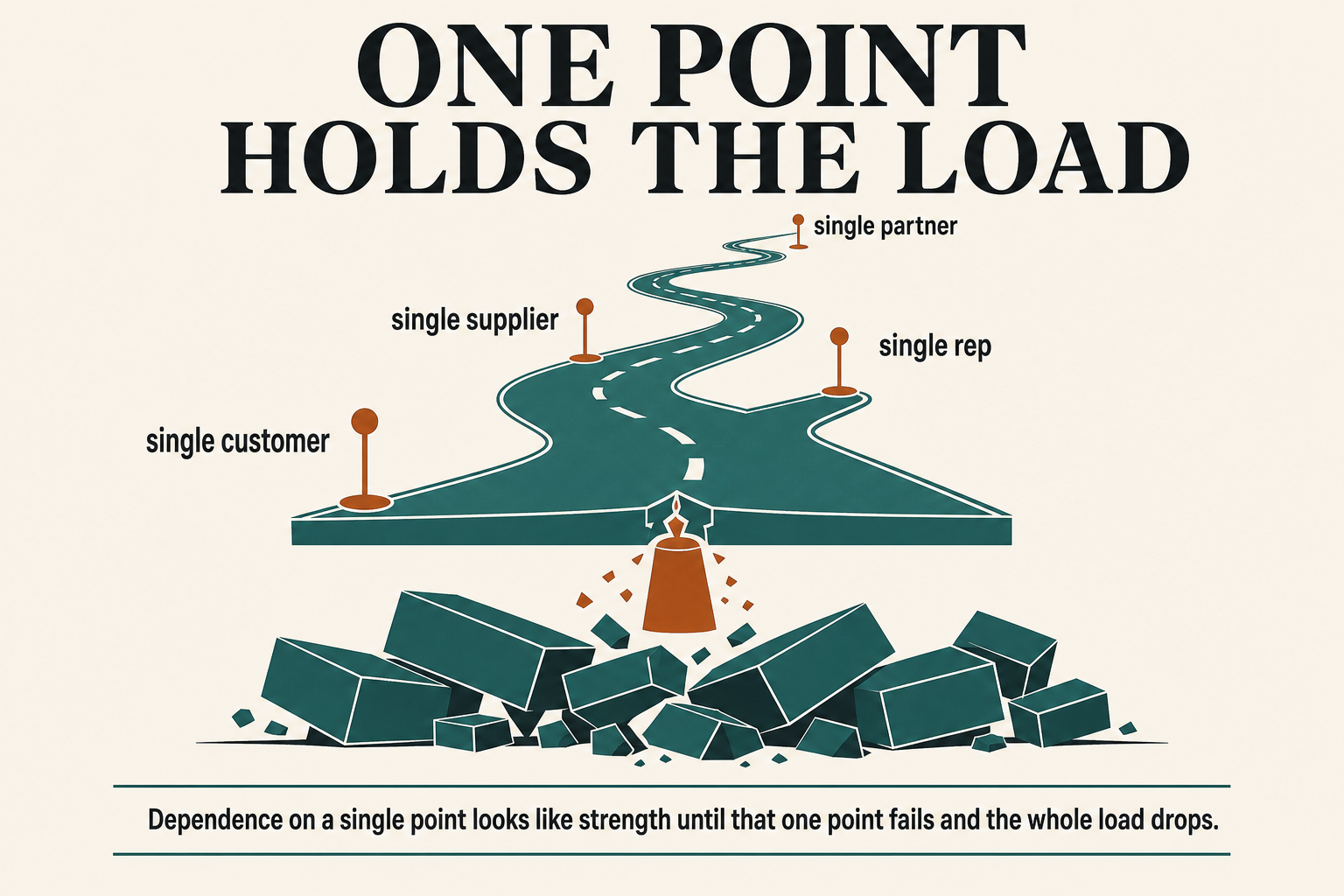
The test that cuts through the disguise is a single question. If this one relationship changed its mind tomorrow, what would I be unable to do? Not unable to do well. Unable to do at all.
That word, unable, is the line between a strong position and a brittle one. A diversified business loses a customer and the others absorb it. A concentrated business loses a customer and loses a function. The first is a bad quarter. The second is an existential event wearing the costume of a bad quarter.
A diversified business loses a customer; a concentrated business loses a function.
Here is the part owners resist. The relationship being good does not reduce the concentration. It hides it. The better the rep performs, the more you route through him, and the deeper the dependency grows precisely because nothing is going wrong. Success quietly increases the very exposure that success made you stop watching. The strongest relationship in your book is often the one you should be most nervous about, not because it is fragile, but because so much rides on it not being.
Where the Permission Actually Lives
Look again at the valve. The manufacturer's first instinct was to treat market entry as a matter of knocking on doors, of convincing the right buyer to say yes. That instinct assumes the buyer can say yes. With critical-service components, he often cannot.
The end users gate those valves. They will not allow an unapproved part into service, and the approval runs on its own clock, months for some, years for others. So the distributor, the one with the budget and the interest and the warm reception, was structurally unable to buy until permission was granted downstream by people who had no reason to hurry.
The fix was not to sell harder. It was to stop selling to preference and start understanding where permission actually lived, then follow that process on its own terms. The concentration here was not on one customer. It was on a single assumed path to the purchase, a path that turned out to depend entirely on a step the seller did not control and had not mapped.
Preference puts you in the room; only permission lets you leave with an order.
Every concentration is a bet that the one thing holding the load will keep holding it. Sometimes that bet is fine. The point is to know you are making it.
How to Tell If This Is You
Run these against your own book before something forces you to.
- Revenue: if your single largest customer changed direction tomorrow, would you lose a quarter or lose a function?
- Supply: for each critical input, do you know your second source by name, or only that one exists in theory?
- Relationships: are your key customer relationships owned by the company, or by the one person who happens to manage them?
- Access: does your entry to any market depend on a partner whose goodwill you have never tested under strain?
- Permission: for anything you sell into gated environments, do you know who actually releases the order, or only who likes the product?
- Trend: is your most successful relationship growing as a share of the whole, and have you noticed?
The relationships that work the best are the ones that hide their load the longest, so the time to map your concentration is while everything is still fine.
You cannot diversify a dependency you have not named. Name them first, then decide which bets are worth keeping. The ones you choose on purpose are strategy. The ones you never noticed are just exposure waiting for a reason.