
The Spike That Exposes What You Built on Hope
Low volume makes fragile processes look finished. People remember missing steps, walk information across gaps, and recover from small mistakes before customers notice. The process appears sound because human effort quietly completes it.
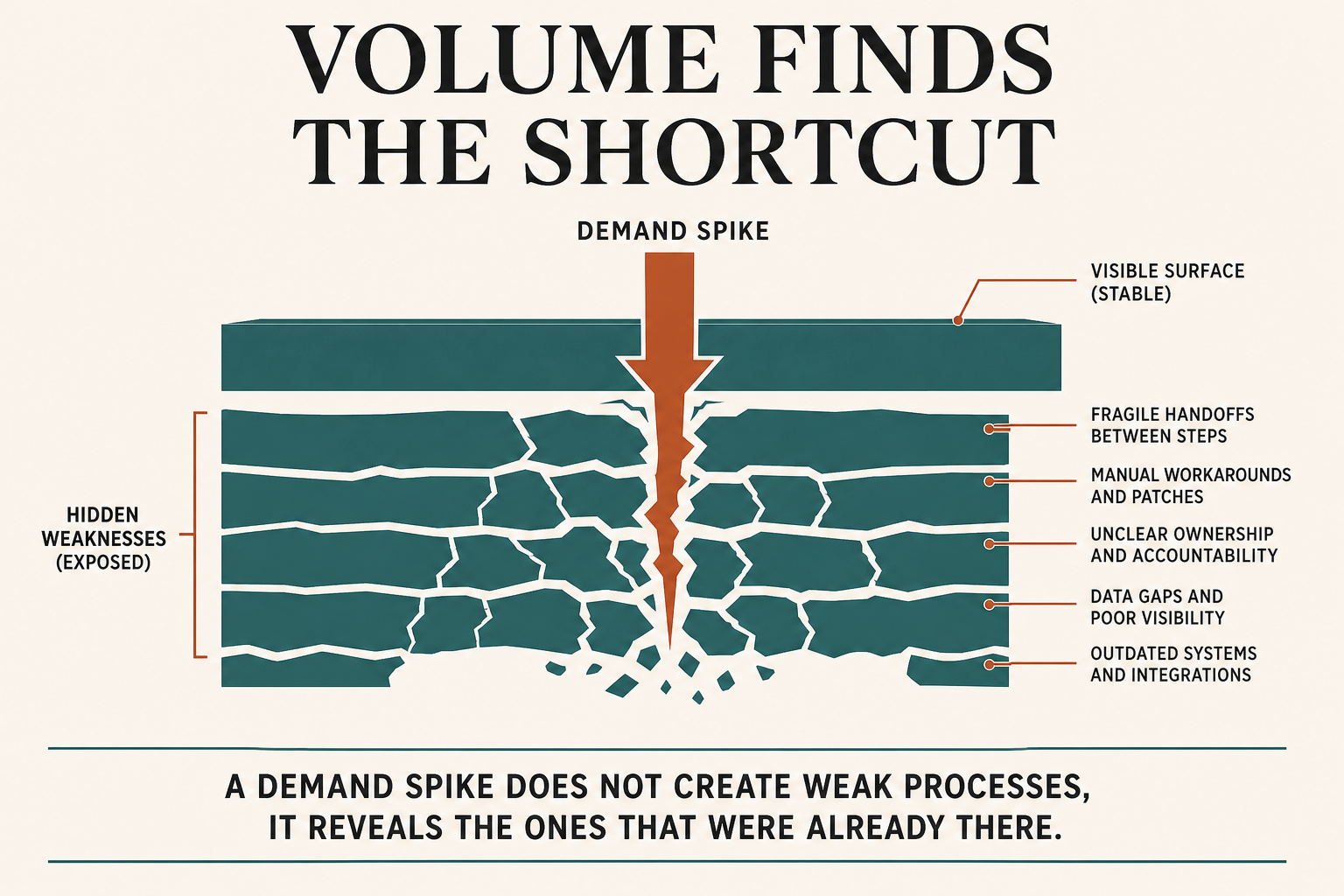
A sudden spike removes that protection. The shortcut that cost a few minutes now compounds across hundreds of transactions. The undocumented exception becomes a queue. The informal handoff becomes the place work disappears.
A paper pick list illustrated this clearly. At forty orders a day, an inefficient sequence barely mattered. At four hundred, people walked the same space in circles because the list followed order timing rather than physical location. The process had not changed. Volume made its hidden cost impossible to absorb.
The same exposure appears when a service business accepts a surge of clients, a property reaches full occupancy, a marketing campaign creates demand fulfillment cannot handle, or a key employee becomes unavailable during the busiest week.
The spike is not the cause. It is the test that removes the extra time and heroics masking the design.
When pressure reveals a seam, document it before calm returns. Otherwise the business will mistake survival for repair and rebuild the same risk before the next spike arrives.
What The Calm Period Was Hiding
The pick list had always been in the wrong order. That was true in July and true in December. The difference was that in July, being wrong cost a few extra minutes per order, absorbed without anyone noticing, folded into a slow afternoon.
At Christmas volume, the same flaw cost hours. Orders that should have shipped same-day were sitting overnight. Pickers were logging more steps than the products they were picking. The warehouse wasn't failing because the season was hard. It was failing because the season revealed something that had been true the whole time and had simply never been tested.
That's the part worth sitting with. A system does not become broken under load. It becomes visible.
A system does not fail under volume. It gets exposed by it.
The calm months are not evidence that a process works. They are evidence that it has not yet been asked to work hard.
Why Slow Season Confidence Is a Trap
Most operators read a quiet quarter as validation. Orders went out, nobody complained, so the system must be sound. That reading skips a question: sound under what conditions?
A pick list in a bad order is not a small inefficiency waiting patiently to be optimized someday. It is a structural cost multiplier, and multipliers only show their size when you multiply by something large. Forty orders times a bad walking path is an annoyance. Four hundred times the same path is a crisis with a deadline attached, because Christmas orders that ship late are not Christmas orders. They're refunds.
Building The Fix Before The Next Spike, Not After
The instinct under pressure is to survive the spike and fix it later. That instinct is exactly backwards, because later is when the fix is easiest to skip. The spike passes, volume drops back to forty orders a day, and the bad pick list goes back to being tolerable. The pressure that revealed the flaw is the same pressure that would have justified the cost of fixing it. Waiting for calm to fix a problem that only calm hides is how the same flaw survives another year.
The right response is to treat the spike as the diagnostic it is, and to fix the actual mechanism, not the symptom on the surface. The surface symptom was pickers taking too long. The mechanism was a list with no relationship to physical layout, and no way to confirm a picker had grabbed the right item until the customer complained.
The fix has to address the mechanism, not the symptom the mechanism produced.
That's a different problem than "print the list faster" or "hire more pickers for December." Both of those treat the pain as a capacity problem. It wasn't. It was an information problem: the list didn't know where things were, and nobody validated the pick against the actual product until it was too late to catch a mistake cheaply.
The fix that holds is the one that changes what information the picker has in hand at the moment of the pick, and the one that catches an error before it becomes a shipped mistake, not after a customer opens the wrong box.
The Scanners That Replaced Hope With Verification
The paper list got replaced with first-generation Symbol scanners, routing each picker through the warehouse in a path that matched shelf location instead of order sequence, and requiring a scan of the shelf followed by a scan of the UPC before a pick counted as complete. That second scan mattered more than it sounds like it should. It meant the system caught a wrong item at the shelf, in the two seconds it takes to scan, instead of catching it three weeks later in a return.
The research and the decision to bring in scanners happened before the next spike hit, not during it and not after. That timing is the whole point. The warehouse wasn't smarter the second December. It was verified instead of hopeful.
The old system hoped the picker was right. The new one confirmed it.
That's the actual upgrade, and it's worth naming precisely, because "we added scanners" undersells it. The company moved from a process that assumed accuracy to a process that checked for it, at the exact moment checking was cheap. A scan takes a second. A wrong item shipped to a customer costs a return, a reship, and a complaint, weeks after the mistake was made and long after it could have been caught for free.
Where To Look Before Your Next Spike
The season that stresses a business is not the enemy. It's the test the calm months never gave you. The question is whether you go looking for the failure point before it finds you, or wait for it to show up wearing a customer complaint.
- Which of your processes has never actually been stress-tested, only run gently enough that its flaws never had room to show?
- Where are you relying on a person to catch an error that a system could catch automatically, at the moment it happens instead of after?
- What would triple volume do to your slowest manual step, and have you actually walked through that math or just assumed it would hold?
- Which shortcut survived because volume was low, not because it was ever actually sound?
- If your busiest period doubled next year, what would break first, and do you know that, or are you guessing?
- Are you fixing root causes during the spike, or just pushing through it and promising yourself you'll deal with it later?
- When calm returns, will the flaw you just saw clearly go back to being invisible, because nothing forces you to remember it?
Volume does not create your weaknesses. It just turns the lights on.
The businesses that hold up under pressure aren't the ones with no flaws. They're the ones that went looking for the flaws while it was still cheap to fix them.